The Dutch-American Friendship Treaty Explained
The Dutch-American Friendship Treaty (DAFT) gives U.S. citizens a way to live in the Netherlands as self-employed business owners. It is not a retirement visa and not a job permit. Here is how it works in 2026, from the Dutch immigration service’s own pages.
The short answer. The treaty route is for U.S. (and Japanese) nationals who will run a real business in the Netherlands. For most business forms the required investment is €4,5001. The IND’s page says first-time applicants must register with the Chamber of Commerce and make the investment within six months of the decision at the latest, while its application form 7524 asks for both with the application; ask the IND which it expects in your case12. The 2026 fee is €4233, the permit lasts up to two years, and extensions need annual accounts1.
Need the route mapped? On a free 30-minute call we look at your income, timeline and shortlist, and tell you what to check next.
What Is the Dutch-American Friendship Treaty?
The treaty lets U.S. citizens apply for the Dutch residence permit for self-employed people on special terms. The IND, the Dutch immigration service, lists its own requirements for applicants who invoke the Dutch-American Friendship Treaty or the Dutch-Japanese Trade Treaty1. You meet the general requirements that apply to everyone, you have U.S. or Japanese nationality, and one of two situations applies to you1:
- You trade between the Netherlands and the United States1.
- You develop and lead the business operations of a Dutch business in which you have invested substantial capital: at least €4,500 for most business forms, €11,250 for an NV, and borrowed money does not count14. Representing a U.S. business in a key position, or practicing an independent profession (not for or on behalf of the government, and not in the healthcare sector), counts as developing and leading a business14.
In one sentence: DAFT is a self-employed residence route for U.S. citizens who will run a real business in the Netherlands. It is not a passive-income visa, not a retirement visa and not permission to take ordinary Dutch employment1.
Why DAFT Stands Out for Americans
For most non-EU nationals, the Dutch self-employed permit is hard to get. The business must serve an essential Dutch interest, assessed by the Netherlands Enterprise Agency (RVO) with a points system: at least 30 points in each of three areas, or 45 for personal experience and 45 for the business plan1. Treaty applicants are assessed on the treaty conditions instead, with no points test, and the general “sufficient means” test does not apply to them; a spouse or minor child joining a treaty entrepreneur, of any nationality, is not refused on that ground either4.
Two practical points help Americans further. U.S. citizens do not need a provisional residence permit (MVV) to enter5, and a treaty applicant who arrives without one sends the residence application by post within three months of arriving1. Form 7524 is for applicants already in the Netherlands; if you want to apply before you travel, ask the Dutch embassy or a consulate in the United States2. None of this makes the Netherlands cheap: price levels there were 15.6% above the EU average in 20256, and housing is tight. The route rewards people with a real business, a housing plan, savings and patience for Dutch administration. Our Netherlands page covers the country as a whole.
Who the Route Suits
The route is built around running your own business, so it suits people whose income comes from their own clients:
- Freelancers and consultants with U.S. or international clients.
- Designers, developers, writers, marketers and other independent service providers.
- Online business owners.
- Founders who want a Dutch base for European operations.
It suits retirees only if they genuinely run a business. And it is not a work permit: with this residence permit, you may work as an employee only if the employer holds a work permit (TWV) for you1.
What Kind of Business Counts?
The business does not need to be large. What the IND tests is a real business that you develop and lead, with substantial capital invested in it; independent professions practiced for or on behalf of the government, or in the healthcare sector, do not count14. Examples of self-employed work that people organize this way:
- Services: consulting, marketing, design and branding, software development, writing and editing, coaching and professional training.
- Ventures: online businesses, e-commerce, creative studios, specialist advisory work and small agencies.
The legal form decides how much capital counts. The Aliens Circular sets these minimums, and borrowed money never counts4:
| Business form | Capital the treaty entrepreneur must hold |
|---|---|
| Sole proprietorship (eenmanszaak) | At least €4,5004 |
| General or limited partnership (vof, or cv for the managing partner) | At least 25% of the partnership capital, and at least €4,5004 |
| Private limited company (bv) | At least 25% of the paid-up capital, and at least €4,5004 |
| Public limited company (nv) | At least €11,2504 |
Registration differs by form too. Registering a new business with the Chamber of Commerce (KvK) costs a one-off €85.15 in 20267, and you need a citizen service number (BSN) to register8. For a sole proprietorship, KvK passes your details to the tax authority, which issues your VAT numbers; a bv or nv is registered through a civil-law notary8.
The Core Requirements in 2026
| Item | What the IND says |
|---|---|
| Nationality | U.S. or Japanese1 |
| Activity | Trade between the two countries, or developing and leading a Dutch business in which you have invested substantial capital14 |
| Substantial capital | At least €4,500 for most business forms, €11,250 for an NV; borrowed money does not count14 |
| Chamber of Commerce | Registration in the Trade Register (KvK)1 |
| Fee (2026) | €423 for a first application or change of purpose, €423 for an extension3 |
| Permit length | Up to 2 years1 |
| Health insurance | Everyone who lives or works in the Netherlands must take out standard Dutch health insurance9 |
The Process Since April 2024
The IND changed how it processes treaty applications in April 2024, so older guides may describe a different order. The IND now works like this1:
- First-time applicants (no Dutch residence permit yet): the IND page gives six months from the date on the decision letter to register with the Chamber of Commerce and make the investment, and says the IND may revoke the permit if you do not1. Form 7524 asks for a Chamber of Commerce extract (no older than three months) and a business bank statement showing the investment with the application2. Ask the IND which applies before you file.
- People already in the Netherlands changing their residence purpose: submit as much of the evidence as possible with the application.
- Extensions: the IND asks for the annual accounts and a balance sheet or income statement, to check that the business has been active and the capital stayed in it.
Around those steps sits the practical work: finding a home, choosing a business structure, bookkeeping from day one, and Dutch health insurance, which is compulsory once you live or work there9. After five years with a residence permit you can apply for permanent residence1.
A practical order for a first-time applicant
- Confirm DAFT is the right route for your business, income, family, housing and tax position before you spend money.
- Travel without an MVV, which U.S. citizens do not need5.
- Register with the municipality within five days of arriving if you will live in the Netherlands for more than four months; registration gives you a BSN10.
- Register the business and invest the capital: form 7524 asks for proof of both with the application2, and the IND page sets six months from the decision as the latest date1. Use your BSN for the KvK registration8, and confirm the timing with the IND.
- Send the IND application by post within three months of arriving1. Applying from the United States instead goes through the Dutch embassy or a consulate2.
- Take out Dutch health insurance and set up bookkeeping from the first invoice9.
Check each step against the IND page for your own situation, because the IND shows different text depending on nationality and current permit1.
What DAFT Really Costs
The €4,500 is capital that stays in your business, not the cost of moving1. A realistic first-year budget separates it from everything else:
| Cost area | What it means | Planning note |
|---|---|---|
| Business investment | At least €4,500 for most business forms1 | Must remain in the business; extensions check this1 |
| Government fee | €423 per application or extension in 20263 | Check the IND fee page before filing |
| Health insurance | Standard Dutch health insurance is compulsory for residents9 | A monthly cost from arrival |
| Housing | Temporary accommodation, deposit, first rent | Often the hardest practical step; budget generously |
| Professional help | Accountant, tax adviser, immigration lawyer | Optional in law, often wise in practice |
| Living reserve | Cash while the business builds up in the Netherlands | Price levels in the Netherlands were 15.6% above the EU average in 20256 |
Housing: Plan It Early
Housing is not part of the IND’s test, but it shapes everything else. Dutch administration runs through municipal registration: if you will live there for more than four months, you register within five days of arriving and receive your BSN10, and KvK needs that BSN to register your business8. Before you sign, ask whether you can register your address with the municipality at that property, and check the registration rules with the municipality itself. Do not plan only around Amsterdam, and do not rely on tourist accommodation for longer than the first weeks. Rotterdam, The Hague, Utrecht, Leiden, Eindhoven and smaller cities are worth comparing on your own budget.
The Tax Questions to Ask Early
DAFT is an immigration route, not a tax plan. Once you live in the Netherlands and run a business there, you deal with Dutch tax and continuing U.S. obligations:
- U.S. citizens remain taxed on worldwide income and must keep filing11. The foreign tax credit can offset Dutch tax on the same income12.
- Self-employment tax: U.S. self-employment tax can apply to citizens working abroad unless a totalization agreement assigns coverage elsewhere13. The United States and the Netherlands have such an agreement14.
- Business structure: sole proprietorship or company, and whether an existing U.S. LLC or S corporation complicates things.
- Dutch bookkeeping, VAT and invoicing rules for your activity. For a sole proprietorship, the tax authority issues your VAT numbers after KvK registration8, and business records must generally be kept for seven years (ten for real estate)15.
- Special regimes: the Dutch 30% facility for incoming workers applies only to people in paid employment16, so a treaty entrepreneur running their own business should not plan around it.
Our sister site eTaxNexus explains self-employment tax abroad for Americans.
Can Your Family Come With You?
Yes, family members can apply to join you, and the treaty route has one clear advantage for them: family members may work in the Netherlands without a work permit; their residence permit says “free to work, no work permit required”1. The treaty entrepreneur, by contrast, needs an employer-held work permit for any paid employment1.
For couples, a useful question is which partner should be the DAFT applicant: usually the one whose business activity and records are clearest, not the one most excited about Amsterdam.
Questions for couples
- Whose business is strongest, and whose income is easiest to document?
- Who can actually run the business from the Netherlands?
- Will the other partner work, study or support the move? Family members may work without a work permit1.
Questions for families
- Which city has school places? Compulsory education starts on the first day of the month after a child turns five, children may start primary school at four, and schools can have waiting lists, so you may apply to several17.
- Can the housing budget support a family home at a registrable address10?
- How will health insurance be arranged for each person9?
- What happens if business income falls in the first year?
Common DAFT Mistakes Americans Make
1. Thinking €4,500 is the cost of moving
It is capital inside the business1. Housing, insurance, advice and living costs come on top.
2. Assuming one fixed order of steps
Older guides give a different order. Form 7524 asks for the KvK extract and proof of the investment with the application2, and the IND page sets six months from the decision as the outer limit1. Confirm with the IND which applies to you.
3. Treating a hobby as a business
Extensions check that the business was active and the capital remained1. Invoices, clients and accounts make the case.
4. Ignoring Dutch tax and bookkeeping
Freelance freedom does not mean informal records. Keep books from the first invoice; records must generally be kept for seven years15.
5. Assuming Amsterdam is the only answer
Rotterdam, The Hague, Utrecht, Haarlem, Leiden, Delft, Eindhoven, Groningen and smaller cities may give a better life for your budget. Visit before you commit.
6. Confusing remote employment with self-employment
If you are an employee of one company, DAFT is probably not your route; employment as an employee needs an employer-held work permit1.
7. Using DAFT as a retirement visa
Retirees who do not want to run a business should look at passive-income routes in other countries instead, such as those on our Portugal, Spain and Italy pages. Our Netherlands Relocation Guide is for people who do plan to run a Dutch business.
Questions Americans Ask About DAFT
Is DAFT only for Americans?
The IND treats the Dutch-American Friendship Treaty and the Dutch-Japanese Trade Treaty together: applicants need U.S. or Japanese nationality1.
Is €4,500 really the investment?
When do I register the business and invest?
How much is the IND fee?
€423 for a first application or change of purpose, and €423 for an extension, in 20263.
Can I work for a Dutch employer on DAFT?
Can freelancers use DAFT?
Can retirees use DAFT?
Only if they genuinely run a business. None of the residence purposes in the Dutch Aliens Decree is a retirement or passive-income permit for people coming from the United States; the only “economically non-active” purpose is for people who already hold EU long-term residence in another EU country18. DAFT is a self-employed route1.
Do Americans need a visa to enter before applying?
No provisional residence permit (MVV) is needed for U.S. citizens5. A treaty applicant without one sends the application by post within three months of arriving1. Form 7524 is for applicants already in the Netherlands; to apply before you travel, ask the Dutch embassy or a consulate in the United States2.
Is the Netherlands expensive?
Price levels were 15.6% above the EU average in 20256, and housing is often the hardest step. Budget for more than the €4,500 investment.
Related Reading
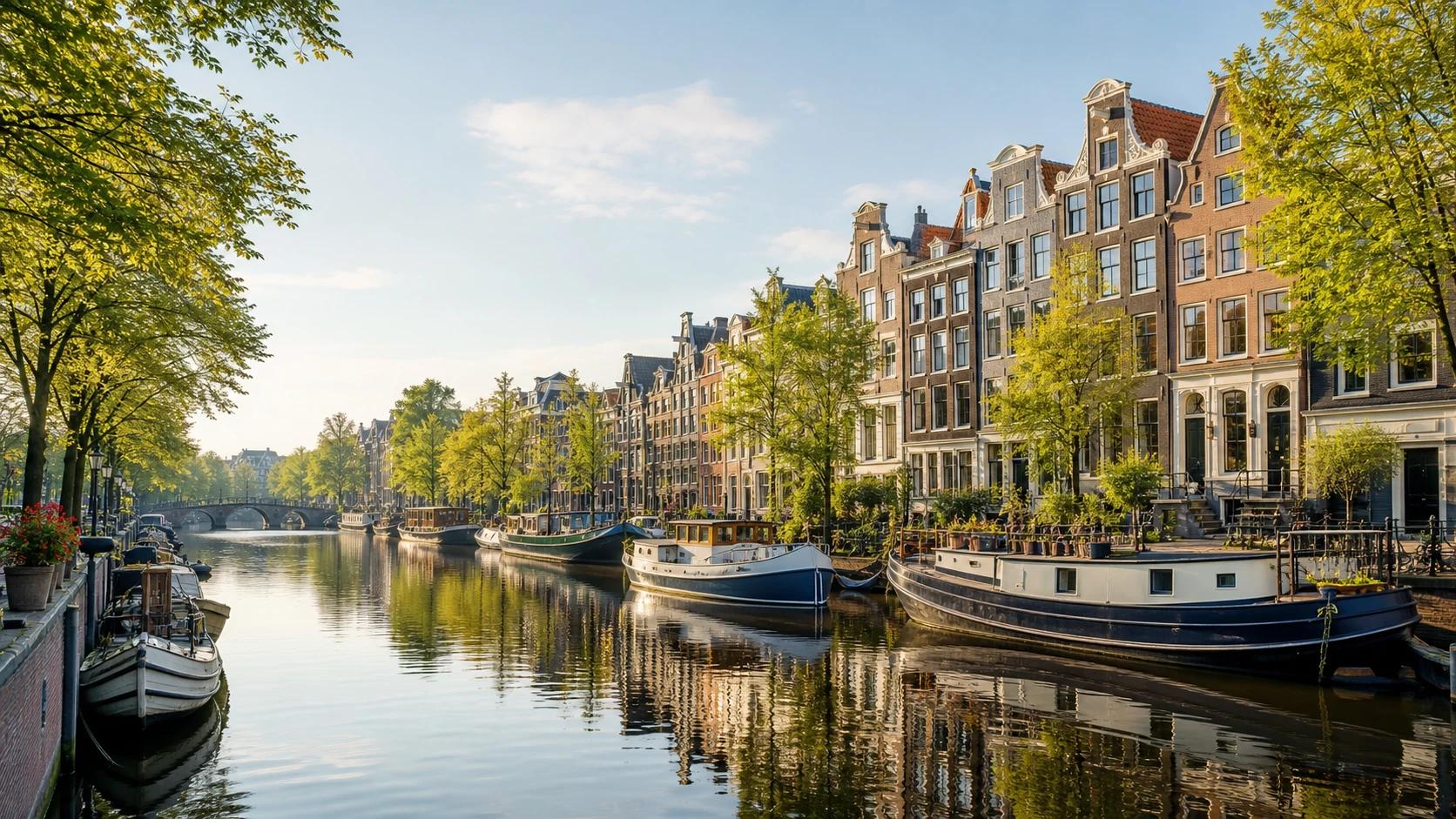
The Netherlands
Our country page for the Netherlands.
See the Netherlands →
Banking in Europe as an American
FATCA, FBAR and why a local account still matters for a Dutch business.
Read the article →
Digital Nomad Visas: 2026 Figures
Remote-work routes in eight countries, with official income tests.
Read the article →Relocation Planner
One workbook for the whole move: a timeline that dates itself from your move day, two budgets, a document tracker and checklists.
$39 USD, instant download. Your card statement and receipt will show MEGACOMMERCIALENT.
Read the Country Pages
The official rules, costs and taxes for each country, checked September 2026.
A question this article does not answer? Write to us and we reply within one business day.
Where Every Figure Comes From
We cite official sources only: laws and official gazettes, government agencies, consulates, the EU and U.S. federal agencies. Each was read on the date shown. If you spot something that has changed, email [email protected].
- Residence permit for a self-employed person, including the Dutch-American Friendship Treaty (page updated September 23, 2026). IND, Netherlands immigration service. Official page. Checked .
- Application form 7524 (version 2026/2): residence to work on a self-employed basis, including the Dutch-American Friendship Treaty. IND, Netherlands immigration service. Official page. Checked .
- Fees: costs of an application. IND, Netherlands immigration service. Official page. Checked .
- Aliens Circular 2000 (B): the Dutch-American Friendship Treaty and substantial capital. wetten.overheid.nl. Official page. Checked .
- Provisional residence permit (MVV): nationalities that do not need one. IND, Netherlands immigration service. Official page. Checked .
- Price level indices, household final consumption, 2025 (dataset prc_ppp_ind_1, updated July 9, 2026). Eurostat, European Commission. Official page. Checked .
- Registration fee: €85.15 (page edited January 1, 2026). KVK, Netherlands Chamber of Commerce. Official page. Checked .
- Business Register and the Tax Administration: BSN, legal forms and VAT numbers. KVK, Netherlands Chamber of Commerce. Official page. Checked .
- Health insurance. Government of the Netherlands. Official page. Checked .
- What do I need to arrange when I come to live in the Netherlands? (registration within 5 days, BSN). Government of the Netherlands (Rijksoverheid). Official page. Checked .
- U.S. citizens and resident aliens abroad. Internal Revenue Service. Official page. Checked .
- Foreign tax credit. Internal Revenue Service. Official page. Checked .
- Self-employment tax for businesses abroad. Internal Revenue Service. Official page. Checked .
- International social security (totalization) agreements in force, POMS GN 01701.005. Social Security Administration. Official page. Checked .
- How long must you keep your records? (7 years; 10 years for real estate). Belastingdienst, Netherlands Tax Administration. Official page. Checked .
- 30% facility for incoming employees (Expat Scheme): paid employment only. Belastingdienst, Netherlands Tax Administration. Official page. Checked .
- When may my child start primary school? (compulsory education from age 5). Government of the Netherlands (Rijksoverheid). Official page. Checked .
- Aliens Decree 2000 (Vreemdelingenbesluit), articles 3.4, 3.5, 3.58 and 3.74. wetten.overheid.nl. Official page. Checked .
General information, not advice. Quantum Jetset does not give legal, tax, immigration, financial or investment advice. Rules and figures change; check the official source and speak to a qualified professional before you act. We take no developer or property commissions. We may receive a referral fee from some professional partners. It never changes what you pay, and we tell you when it applies.
Could DAFT Be Your Door Into Europe?
We compare the Netherlands with other European routes for your business and household, and map the steps before you spend.